Surgical Hair Restoration
Beard Transplant
A permanent solution for patchy growth, sparse cheeks, weak mustache or goatee areas, scar camouflage, and beard shaping — customized for natural, long-lasting results.
Dr. Robert Drummond, MD/PhD
Hair Restoration · Beverly Hills
“A beard transplant is among the most artistically demanding procedures we do. Facial hair has a unique flat, wide-angle growth pattern — it curls outward, not inward. Matching that pattern across the beard, mustache, goatee, and sideburns requires a level of design precision that takes years to master.”
Dr. Robert Drummond, MD/PhD
What Is a Beard Transplant?
A beard transplant is a permanent solution for individuals looking to enhance beard density, fill patchy areas, improve symmetry, or restore facial hair due to genetics, scarring, or prior procedures. At Crown Hair Institute, every treatment is customized to achieve natural, long-lasting results.
We use advanced FUE harvesting techniques to take individual follicular units from the scalp donor area and place them throughout the beard, mustache, goatee, sideburns, or any area of the face where hair is absent, sparse, or patchy. Each graft is placed at a precisely calibrated angle, depth, and direction that mirrors the natural growth pattern of facial hair — nearly parallel to the surface, typically at a 10 to 20 degree angle, following the complex directional flow of the jaw, chin, and upper lip.
The transplanted follicles are permanent and behave exactly like native facial hair. They grow, can be shaved, trimmed, or styled. Most patients achieve a full, natural-looking beard in a single session, though a touch-up may be scheduled at 12 months to refine density.
Patients choose facial hair transplants for a variety of reasons. Some may have had difficulty growing a mustache or beard their entire life. Others may want to fill in small patches to achieve a uniform thickness. Facial hair transplants are also popular for FTM transgender patients who desire facial masculinization.
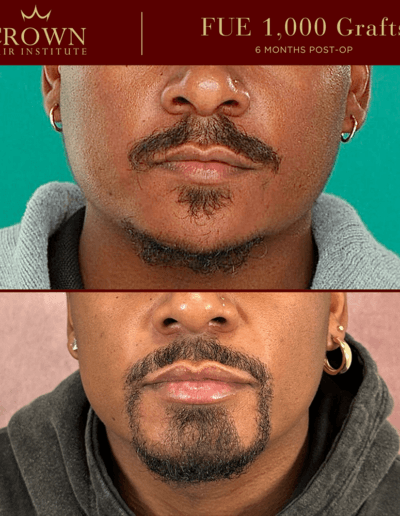
Key Benefits
Investment
Investment in Your Confidence
Price
$6.25 per graft
Beard Transplant Pricing (2026) — Tier 1: Small beard or patch repair, $6K–$8K. Tier 2: Medium beard enhancement, $8K–$10K. Tier 3: Full beard or revision case, $12K–$15K. Final cost is determined after your consultation with your doctor. You can get an approximate price range during your complimentary discovery call if you submit your photos prior.
Financing available through Cherry
Plans from 0% APR — apply in minutes
What to Expect
Procedure Day
The facial hair transplant takes 4 to 6 hours under local anesthesia. Tiny scabs form around each graft site on your face and small dot marks are visible at the scalp donor site. You go home the same day.
Initial Healing
Small scabs form at each recipient site across the beard area. Mild redness is expected. Avoid shaving, touching, or scrubbing the beard area. Sleep elevated to minimize swelling.
Scabs Release
Scabs gradually release. The face looks noticeably cleaner and you can return to most normal activities. The donor scalp area heals rapidly, with tiny marks fading within 2 weeks.
1-Month Follow-Up
Transplanted facial hairs shed as follicles enter a telogen resting phase. This is normal — the roots remain alive and active below the surface. Your 1-month follow-up confirms healing is on track.
3-Month Follow-Up
Transplanted follicles begin producing new facial hair. Growth is initially fine and soft. Your 3-month follow-up documents early progress with photographic comparison.
6-Month Follow-Up
Facial hair gains caliber and density month over month. You can shave and groom normally. Your 6-month follow-up includes photographic comparison to document progress.
9-Month Check-In
Continued density improvement. Your surgeon evaluates progress, compares with earlier photos, and determines if any touch-up grafts are needed for optimal density.
Full Result
Facial hair has reached full caliber, density, and coverage. Your 12-month follow-up confirms your final result. The result is indistinguishable from natural beard growth. Results are permanent.
Frequently Asked Questions
Can I create a beard if I have never been able to grow one?
Yes. Men who cannot grow facial hair due to genetics, scarring, or alopecia can achieve a full natural beard through transplantation. Dr. Truesdale will design a beard shape suited to your facial structure and place grafts to match natural directional growth.
Will the transplanted beard look natural?
Yes, when performed with surgical precision. The key is placing each graft at the correct angle (nearly parallel to the skin) and in the correct growth direction for each region of the face. Dr. Truesdale maps the recipient sites individually to ensure the beard looks and grows naturally.
Where is the donor hair taken from?
Follicles are harvested from the scalp — typically from the back and sides. Scalp hair adapts to its new environment and begins behaving more like facial hair over time, though it may require slightly more frequent trimming initially.
Can a facial hair transplant fill a scar or burn area?
Yes. Grafts can be placed into scar tissue, burn areas, or regions affected by traction or trauma. Dense scar tissue may require smaller placement density and potentially a staged approach. Dr. Truesdale will assess scar tissue quality at consultation.
When can I shave after a beard, mustache, or sideburn transplant?
It is usually safe to shave 10 days after surgery. However, if you had very little facial hair to begin with, you may not have much to shave. The natural process of new hair growth can take several months to begin.
How long do the results last?
The transplanted hair follicles may fall out in about 4 to 6 weeks, but the follicles will start to grow again at 12 weeks and will continue to grow throughout life. Similar to hair transplantation on the top of your head, facial hair transplant results can last for many years.
What is recovery like?
For the first few days after surgery, you will have mild redness at the donor site as it heals. The recipient site (facial area) will also be mildly red, with some swelling and scabs at the graft sites. This is completely normal and expected, and the swelling should resolve within a week.
Is a beard transplant available for transgender patients?
Absolutely. Crown Hair Institute welcomes transgender men and gender-diverse patients seeking facial masculinization. Dr. Truesdale has experience designing beard and mustache patterns appropriate to individual facial structure and masculinization goals.
Your transformation starts
with a conversation.
30 minutes with Dr. Drummond. A custom plan for your hair type and goals. No obligation, no pressure — backed by the Crown Promise.
No commitment required · Virtual consultations available
Send us a message.
Explore More
Related Procedures
Non-Surgical
Exosome Therapy
Concentrated stem-cell signaling factors stimulate dormant follicles and accelerate graft survival when combined with your transplant.
Learn MoreNon-Surgical
PRP Therapy
Your body's own platelet-rich plasma activates growth factors that strengthen existing follicles and complement surgical results.
Learn MoreNon-Surgical
Topical Treatments
Medical-grade scalp serums and shampoos engineered to maintain your transplant and reinforce native hair density.
Learn MoreNon-Surgical
Medication
FDA-approved finasteride and minoxidil protocols that stabilize hair loss and protect your surgical investment over time.
Learn More