Surgical Hair Restoration
FUT Hair Transplant
The strip method delivers the highest possible graft yield in a single session — the preferred approach for patients with advanced hair loss who need maximum coverage.
%20(1).jpg&w=1920&q=75&dpl=dpl_Er1m3HztQFU1M7UBKefTiasSHg6u)
Dr. Truesdale & Dr. Drummond
Crown Hair Institute · Beverly Hills
“FUT remains the most efficient way to move a large number of healthy grafts in one day. For the right patient — someone with significant crown or top coverage goals — it gives us the density and coverage that simply isn't achievable any other way.”
Dr. Carl Truesdale, MD
What Is FUT Hair Transplant?
Follicular Unit Transplantation (FUT) — also known as Linear Strip Excision (LSE) — involves the surgical removal of a narrow strip of donor scalp from the back of the head. This strip is then processed by a team of skilled technicians under stereoscopic microscopes, dissecting it into individual follicular unit grafts of one to four hairs each.
Because the strip contains thousands of densely packed follicles, FUT allows Dr. Truesdale to harvest a significantly higher number of grafts in a single session compared to FUE alone. This makes it the preferred technique for patients with Norwood IV–VI hair loss who require large areas of coverage — the crown, mid-scalp, and frontal zone simultaneously.
The donor incision is closed with a trichophytic technique, allowing hair to grow through the scar line and making it nearly imperceptible at normal hair lengths. FUT and FUE can also be combined across staged sessions to maximize the lifetime graft pool.
While anyone can potentially undergo the FUT procedure, patients with longer hair in the back of the head tend to favor this technique. Because FUT involves removing a strip of hair from the back of the head, a very fine horizontal scar is left where the strip is removed. Individuals undergoing a second hair restoration procedure may also benefit from FUT if they have very limited donor sites remaining.
Key Benefits
Investment
Investment in Your Confidence
Price
Starting at $14,000
FUT pricing is based on graft count and session length. Most patients require 2,000–3,000 grafts. Final cost is determined after your consultation with your doctor. You can get an approximate price range during your complimentary discovery call if you submit your photos prior.
Financing available through Cherry
Plans from 0% APR — apply in minutes
What to Expect
Procedure Day
FUT is performed under local anesthesia in our Beverly Hills surgical suite and typically takes 8 to 12 hours. You are awake throughout — light sedation keeps you comfortable. You go home the same day with post-operative instructions.
Immediate Recovery
Mild swelling of the forehead is common and peaks around day 3. The donor site is closed with sutures that will be removed at 10–12 days. The recipient sites develop small scabs around each graft.
Suture Removal
Sutures are removed at your follow-up appointment. By this point most patients are comfortable in social settings with their hair styled normally. The donor scar is a fine, pale line.
1-Month Follow-Up
Transplanted hairs begin to shed — this is expected and does not indicate failure. The follicle root remains viable and enters a new growth cycle. Your 1-month follow-up confirms healing is on track and the donor site is recovering well.
3-Month Follow-Up
New hair shafts begin emerging from the transplanted follicles. Hair initially grows fine before gaining caliber. Your 3-month follow-up documents early progress with photographic comparison.
6-Month Follow-Up
Density in the recipient area becomes noticeably improved. Your 6-month follow-up includes photographic comparison to document progress and review maintenance recommendations.
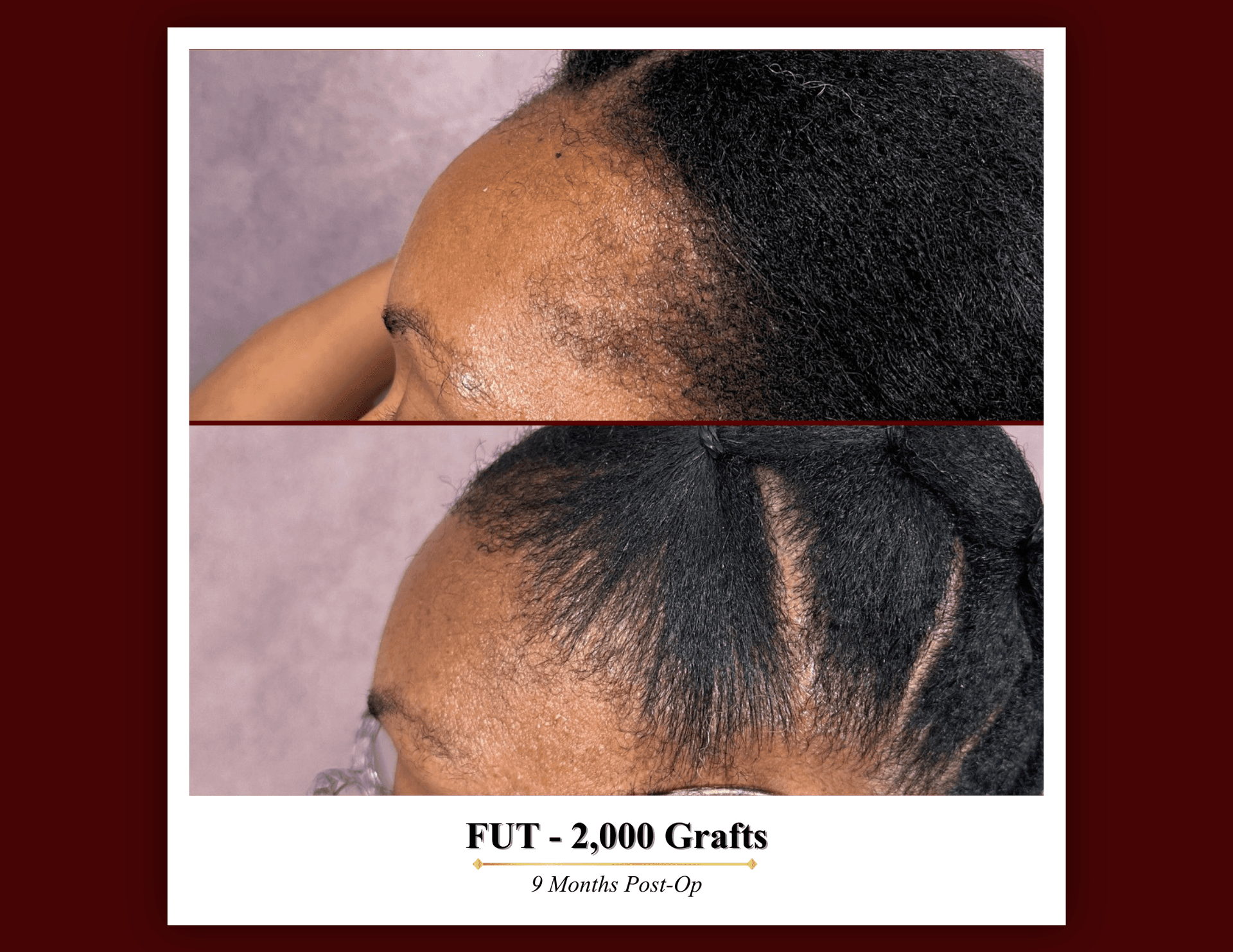
9-Month Check-In
Continued density improvement. Your surgeon evaluates progress, compares with earlier photos, and determines if any adjustments to your maintenance plan are needed.
Final Result
Full density and texture are established. The donor scar has matured to a faint white line obscured by overlying hair. Your 12-month follow-up confirms your final result. Results are permanent and will continue growing for life.
Frequently Asked Questions
What is the difference between FUT and FUE?
FUE extracts individual follicles one by one, leaving tiny dot scars. FUT removes a strip of scalp tissue and dissects it into individual grafts, leaving a linear scar at the donor site. FUT allows more grafts per session and is often preferred for advanced hair loss. The two techniques can be combined across staged sessions to maximize total lifetime graft yield.
Will the scar be visible?
Dr. Truesdale uses a trichophytic closure technique in which the wound is beveled so hair grows directly through the scar line. At normal hair lengths (1 inch or more at the back), the scar is virtually undetectable. Patients who keep their hair very short at the back may notice a faint line.
Who is FUT best suited for?
FUT is ideal for patients with Norwood IV–VI hair loss who want maximum coverage in a single procedure. It is also appropriate for patients who want to preserve their FUE donor area for future procedures, or who wear their hair at a length that conceals a donor scar.
Can I have both FUT and FUE?
Yes. Many patients undergo FUT for their primary session to maximize graft count, then return for a subsequent FUE session from the remaining donor area. This staged approach allows patients to achieve the highest possible lifetime graft total.
Is FUT painful?
The procedure is performed under local anesthesia, so you feel no pain during surgery. There is typically more post-operative donor site discomfort with FUT than FUE — the donor area may feel tight and sore for one to two weeks. Oral pain medication is prescribed for the first few days.
How long before I see results?
Initial growth begins around months 3–4 after transplanted hairs shed and re-enter the growth cycle. Significant visible improvement is typically seen at month 6–8, with full final results at 12–18 months.
How long does FUT surgery take?
With the FUT (strip) method, all grafts are removed at once with the removal of the strip. These grafts are then separated into follicular units under a microscope. This completes the first half of the procedure and can sometimes be completed in as little as 2 hours. The second half — graft implantation — follows the same process as FUE.
What is recovery like?
You may feel a little sleepy or groggy after your procedure, so make sure someone is available to pick you up from the clinic to take you back home or to your hotel. Clear instructions will be relayed to both you and your caregiver about appropriate medications to take after surgery.
What can I expect after treatment?
After your surgery, you may be slightly sore for a few days, but you will have medication to help with the sensation. Within 1 week, you will follow up with your doctor who will check your donor site and recipient site for any possible concerns. You will continue to follow up with your doctor at various intervals to monitor the progression of your new hair.
What is scarring like after FUT surgery?
After the FUT procedure, there will be a very fine horizontal scar in the area of the donor site. Our surgeons use special suture techniques to keep your scar to an absolute minimum. At normal hair lengths, the scar is virtually undetectable.
Your transformation starts
with a conversation.
30 minutes with Dr. Drummond. A custom plan for your hair type and goals. No obligation, no pressure — backed by the Crown Promise.
No commitment required · Virtual consultations available
Send us a message.
Explore More
Related Procedures
Non-Surgical
Exosome Therapy
Concentrated stem-cell signaling factors stimulate dormant follicles and accelerate graft survival when combined with your transplant.
Learn MoreNon-Surgical
PRP Therapy
Your body's own platelet-rich plasma activates growth factors that strengthen existing follicles and complement surgical results.
Learn MoreNon-Surgical
Topical Treatments
Medical-grade scalp serums and shampoos engineered to maintain your transplant and reinforce native hair density.
Learn MoreNon-Surgical
Medication
FDA-approved finasteride and minoxidil protocols that stabilize hair loss and protect your surgical investment over time.
Learn MoreOur Guarantee
At Crown Hair Institute, we stand behind every procedure. If your transplanted grafts do not achieve the agreed-upon density within 18 months, we will perform a complimentary touch-up procedure for no additional surgeon's fee.